
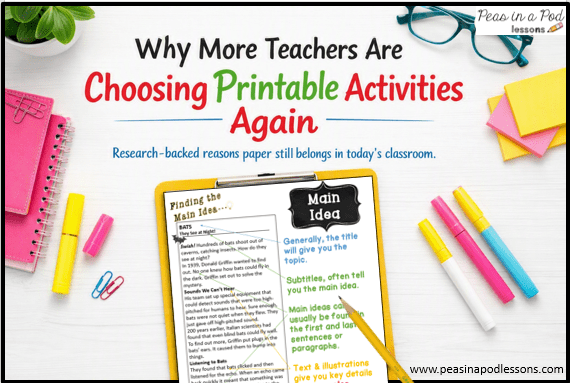
Technology has transformed the way we teach, but it hasn’t replaced the value of learning on paper. Research shows that handwriting and interacting with printed pages help students think more deeply, retain information longer, and stay engaged.
By Melissa Bonito | Veteran Teacher • Creator of Peas in a Pod Lessons
🍎 Research-Backed TAKEAWAYS
Printable activities…
✔️ Help students understand what they read more deeply
✔️ Support better memory through handwriting
✔️ Encourage close reading and annotation
✔️ Reduce screen fatigue
✔️ Give teachers a ready-to-use lesson for tomorrow
After years of adding more technology to our classrooms, many teachers are rediscovering something wonderfully simple.
Paper still works.
Not because technology is bad.
Not because digital learning doesn’t have incredible benefits.
But because some learning experiences simply work better with a pencil in hand.
And honestly…
Students need a break from another screen.
I know I do!
Spend more time teaching instead of troubleshooting.
🔍 What the Research Says
Technology has transformed education in amazing ways. But, research continues to remind us that print still plays an important role in literacy instruction.
✅ 1. Handwriting Helps Learning Stick
🔍 Research suggests that writing by hand does more than record information—it helps students process it. One landmark study found that students who took notes by hand outperformed laptop users on questions requiring conceptual understanding because handwriting naturally encourages summarizing instead of copying.
More recently, brain imaging studies have shown that handwriting activates broader networks involved in memory and learning than typing.
🔗 Read the study:
https://www.sciencedirect.com/science/article/pii/S0360131524001210
✅ 2. Printed Books Support Comprehension
🔍 A 2021 meta-analysis reviewing 39 studies found that young children generally demonstrated stronger reading comprehension when reading printed books compared with identical digital versions. Researchers also found that adult guidance during print reading was especially beneficial.
🔗 Read the study:
https://journals.sagepub.com/doi/abs/10.3102/0034654321998074
✅ 3. Print Encourages Deeper Reading
🔍 More recent research found that students often processed longer and more complex texts more deeply on paper than on screens—even when students believed they understood both equally well.
Researchers described digital reading as encouraging more “shallow processing” for some reading tasks.
🔗 Read the study:
https://www.sciencedirect.com/science/article/pii/S0360131524001210
Sometimes a screen is exactly the right tool.
Sometimes a pencil is.
❤️ Why I Love Printable Activities
After more than twenty years in elementary classrooms, I’ve learned something.
Teachers don’t need more complicated.
They need lessons that work.
When I first started creating classroom resources, I wasn’t thinking about educational research.
I was thinking about Tuesday.
You know the kind.
Open House is tomorrow.
Your to-do list is already too long.
And somehow, you still need a lesson your students will actually enjoy.
I didn’t need another login or five devices that needed charged!

Printable activities are hands-on in a way that screens simply can’t replicate.
Students aren’t just clicking.
- They’re highlighting.
- They’re annotating.
- They’re cutting.
- They’re folding.
- They’re writing.
- They’re creating something that’s uniquely theirs.

That’s one of the reasons I love using foldables and crafts.
They transform a lesson into an interactive experience that encourages students to think, organize ideas, and engage with the content in meaningful ways. Best of all, students leave with something they’re proud of—a finished piece they can revisit later.
There’s something special about walking into a classroom filled with colorful foldables, interactive notebook pages, and student work proudly displayed on the walls.
Those displays don’t just brighten the room.
They celebrate learning.
✏️ When students work on paper…
✔️ They highlight evidence.
✔️ They circle unfamiliar vocabulary.
✔️ They reread.
✔️ They demonstrate better recall.
✔️ Students summarize instead of copy.
✔️ Handwriting notes instead of typing helps the brain better process information.
⭐ Teacher Favorites
Main Idea Reading Passages
Annotate text, build reading skills, and spot writing structures with this one simple tool!

Text Structure Reading Passages
Students identify organizational patterns while marking directly on the text.

US Map Unit – States & Capitals
Help students write stronger evidence-based responses while citing text evidence.

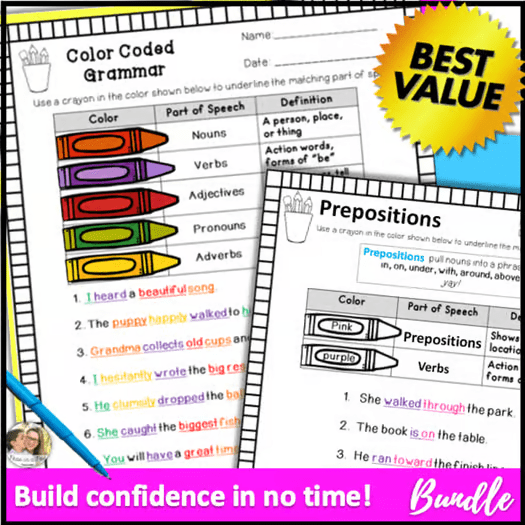
Grammar Worksheets
These are ready-to-print grammar practice designed for busy teachers.
A Straight Forward Writing Program
Find classroom-tested writing lessons, ready for tomorrow.
🌿 The Bottom Line
Technology has transformed education for the better.
I’m grateful for all the ways it helps us teach, differentiate, and connect with students.
But after more than twenty years in the classroom, I’ve learned something.
The goal has never been to use more technology.
The goal has always been to choose the right tool for the lesson.
Sometimes that’s a Chromebook.
Sometimes it’s an interactive whiteboard.
And sometimes…
It’s a printed reading passage, a highlighter, and a freshly sharpened pencil.
Technology has earned its place in our classrooms.
But so has paper.
💬 Let’s Keep the Conversation Going
Have you noticed your students responding differently to printable activities?
I’d genuinely love to hear what’s working in your classroom.
Share your thoughts in the comments below!
📚 Sources
Reading & Print Comprehension
Aydin, G., et al. (2021). Reading on Paper Versus Screens: A Meta-Analysis. Review of Educational Research.
🔗 https://journals.sagepub.com/doi/abs/10.3102/0034654321998074
Delgado, P., et al. (2024). Reading Comprehension Across Print and Digital Media. Computers & Education.
🔗 https://www.sciencedirect.com/science/article/pii/S0360131524001210
Handwriting & Memory
Mueller, P. A., & Oppenheimer, D. M. (2014). The Pen Is Mightier Than the Keyboard. Psychological Science.
🔗 https://journals.sagepub.com/doi/10.1177/0956797614524581
Askvik, E. Ø., et al. (2024). The Importance of Cursive Handwriting Over Typewriting for Learning in the Classroom. Frontiers in Psychology.
🔗https://www.frontiersin.org/journals/psychology/articles/10.3389/fpsyg.2024.1349547/full
